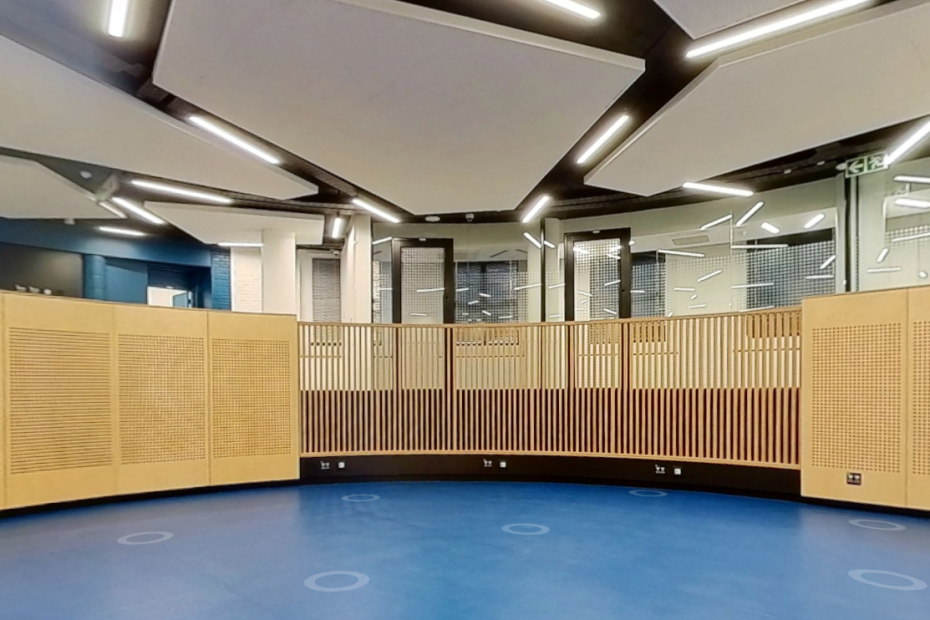
The living lab is a collaborative platform at the Faculty of Health Sciences at UP (FHS) where researchers, businesses, government agencies, and citizens come together to test and co-create innovations across various fields such as healthcare, technology, education, urban planning, and sustainability. Here are its key features:
- Transdisciplinary collaboration: Living labs foster collaboration among diverse stakeholders, including researchers, industry partners, government officials, and community members. This multidisciplinary approach encourages creativity, innovation, and comprehensive problem-solving.
- User-centric approach: Central to living labs is end-users’ involvement in the innovation process. Their insights, needs, and feedback play a pivotal role in shaping the development of new solutions and services.
- Experimentation and testing: Living labs provide a platform for experimenting with prototypes, new technologies, policies, or services. This allows stakeholders to gather data, evaluate effectiveness, and iterate on solutions in a controlled environment.
- Data collection and analysis: Living labs employ various methods for collecting and analysing data, such as sensors, surveys, interviews, and observations. This data-driven approach helps stakeholders gain insights into user behaviour, preferences, and the impact of interventions.
- Iterative process: Development within living labs is often iterative, with continuous feedback loops between stakeholders. This enables rapid prototyping, refinement, and adaptation based on real-world insights.
- Scalability and replicability: Successful innovations tested in living labs can be scaled up and replicated in other contexts. This ensures that the benefits of innovation can reach a broader audience beyond the initial testbed and can be commercialised.
Living labs serve as dynamic ecosystems for innovation, experimentation, and collaboration, aiming to address complex societal challenges and improve the quality of life for individuals and communities.
Below is a virtual tour of the completed space.